


What Is a Reciprocating Air Compressor? Complete Guide for 2026
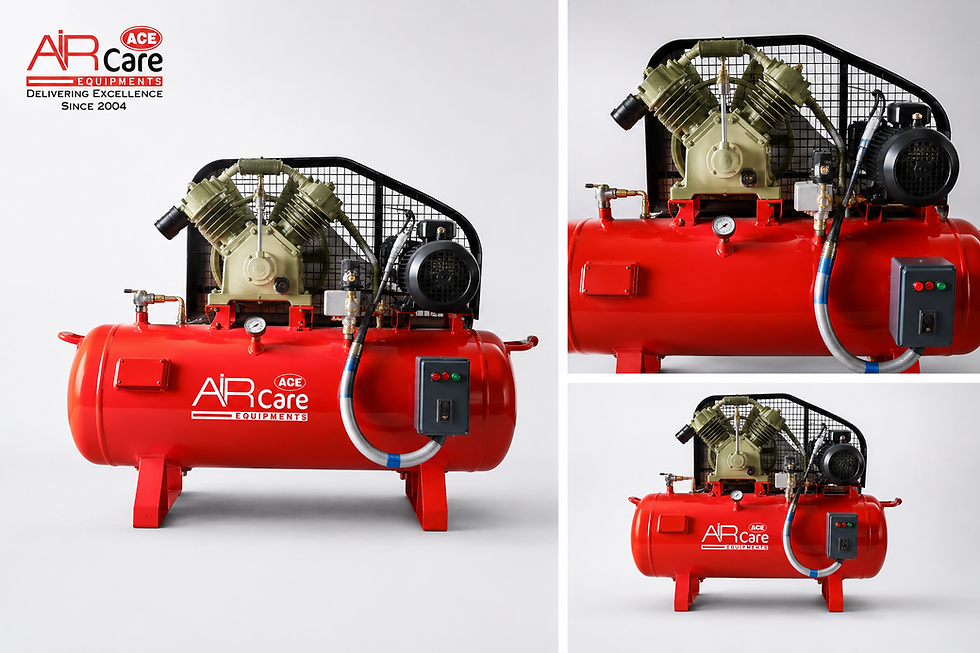
A Reciprocating Air Compressor is a positive-displacement machine that uses a piston moving inside a cylinder to draw in atmospheric air, compress it, and deliver it at a higher pressure. Also known as a Reciprocating Piston Compressor, this equipment is widely used in workshops, automotive garages, manufacturing plants, construction sites, paint shops, packaging units, and maintenance departments.
For businesses that need reliable compressed air for intermittent or medium-duty applications, piston compressors remain a practical and cost-effective choice. They can build pressure quickly, support a wide range of pneumatic tools, and are available in configurations for standard, oil-free, and high-pressure requirements.
Air Care Equipment provides industrial compressed-air solutions designed to support diverse operational needs. Whether a business requires a compact workshop machine, Oil Free Air Compressors for clean-air applications, or High Pressure Air Compressors for demanding industrial work, choosing the right compressor configuration is essential for performance, efficiency, and long-term reliability.
Understanding a Reciprocating Air Compressor
A reciprocating air compressor works through the back-and-forth motion of a piston. The piston is connected to a crankshaft, which is powered by an electric motor or engine. As the crankshaft rotates, it moves the piston up and down inside a sealed cylinder.
During the downward stroke, the piston creates low pressure inside the cylinder. This pressure difference allows atmospheric air to enter through the suction or inlet valve. During the upward stroke, the piston reduces the volume available to the trapped air. As the air volume decreases, its pressure increases. Once the pressure inside the cylinder becomes higher than the pressure in the delivery line or storage tank, the discharge valve opens and releases compressed air.
The compressed air is generally stored in an air receiver tank. The tank helps maintain a stable supply of air and reduces frequent start-stop cycles. It also gives some time for air to cool and for moisture to separate before the air reaches downstream equipment.
In simple terms, the operating sequence is:
Air enters the compressor cylinder through the inlet valve.
The piston moves upward and compresses the air.
The discharge valve opens when the required pressure is reached.
Compressed air moves into the receiver tank or air line.
The cycle repeats whenever air demand causes pressure to drop.
Because it compresses a fixed volume of air in every cycle, a Reciprocating Air Compressor is classified as a positive-displacement compressor. This design is especially known for achieving high pressures with a relatively straightforward mechanical system.
Main Components of a Reciprocating Piston Compressor
Understanding the parts of a Reciprocating Piston Compressor helps users make better decisions regarding installation, maintenance, and troubleshooting.
Cylinder
The cylinder is the enclosed chamber where air is compressed. It must withstand heat, pressure, and repeated piston movement. The number and arrangement of cylinders can vary depending on the compressor’s capacity and pressure rating.
Piston
The piston moves inside the cylinder to pull in and compress air. Piston rings create a seal between the piston and cylinder wall, helping prevent air leakage and maintaining compression efficiency.
Crankshaft and Connecting Rod
The crankshaft converts the rotary motion from the motor into the reciprocating movement needed by the piston. The connecting rod links the crankshaft and piston.
Suction Valve
The suction valve allows air to enter the cylinder during the intake stroke. It closes when compression begins, preventing air from escaping back through the inlet.
Discharge Valve
The discharge valve opens when compressed air reaches sufficient pressure. It sends the air to the delivery pipe, receiver tank, or downstream system.
Air Receiver Tank
The air receiver stores compressed air and supports stable pressure delivery. It also helps reduce pressure fluctuations during tool use. Since compressed air can contain moisture, receiver tanks should be drained regularly.
Motor and Drive System
An electric motor commonly powers industrial compressors. Depending on the design, the motor may connect directly to the compressor pump or operate through a belt-and-pulley arrangement.
Pressure Switch and Safety Valve
The pressure switch starts and stops the motor according to preset pressure limits. The safety valve protects the system by releasing air if pressure rises above a safe operating level.
Air Filter and Lubrication System
The intake air filter helps stop dust and airborne contaminants from entering the compressor cylinder. In lubricated machines, the oil system reduces friction and wear between moving components. Oil-free designs use materials and engineering methods intended to minimize or eliminate oil contamination in the compressed-air stream.
How Does a Reciprocating Air Compressor Work?
The compression process has four basic stages: intake, compression, discharge, and pressure control.
1. Intake Stroke
When the piston moves downward, the cylinder volume increases. The pressure inside the cylinder falls below atmospheric pressure. The inlet valve opens, allowing outside air to enter the cylinder through the air filter.
2. Compression Stroke
As the piston moves upward, the inlet valve closes. The piston reduces the volume of air inside the cylinder. This raises both the air pressure and temperature.
3. Discharge Stroke
Once compressed air reaches a higher pressure than the receiver tank or delivery line, the discharge valve opens. The compressed air flows out of the cylinder and into the storage tank or connected air system.
4. Pressure Regulation
The compressor continues operating until the receiver reaches the set cut-out pressure. At this point, the pressure switch stops the motor. When compressed-air use lowers the tank pressure to the cut-in level, the motor starts again and the compression cycle resumes.
This system makes reciprocating compressors suitable for applications with fluctuating demand. For example, an automotive workshop may need compressed air for tyre inflation, spray painting, impact wrenches, cleaning, and other short-duration tasks throughout the day. A receiver tank allows the compressor to meet those demand peaks without operating continuously at full capacity.
Types of Reciprocating Air Compressors
A Reciprocating Air Compressor can be classified according to its number of stages, cylinder action, lubrication method, cooling design, and pressure range.
Single-Stage Reciprocating Air Compressor
In a single-stage compressor, air is compressed in one cylinder from atmospheric pressure to the required delivery pressure. These machines are commonly used for general workshop tasks, small manufacturing operations, cleaning, inflation, pneumatic tools, and routine maintenance work.
Single-stage units are typically selected when moderate pressure and lower-to-medium airflow are sufficient.
Two-Stage Reciprocating Air Compressor
A two-stage compressor compresses air in two steps. Air first enters a low-pressure cylinder, then passes through an intercooler before entering a smaller high-pressure cylinder for further compression.
This staged process helps manage heat and improves efficiency when higher pressure is required. Two-stage models are often used in industrial plants, fabrication units, automotive service stations, heavy-duty workshops, and applications requiring regular high-pressure output.
Single-Acting Compressor
A single-acting compressor compresses air on one side of the piston. This is a common design for smaller and medium-capacity equipment.
Double-Acting Compressor
A double-acting compressor compresses air on both sides of the piston. It can provide higher capacity and is generally associated with larger industrial applications.
Lubricated Compressor
Lubricated piston compressors use oil to reduce friction and wear in moving parts. They are suitable for many industrial and mechanical uses, including workshops, engineering operations, construction, and general pneumatic-tool applications.
However, oil-lubricated air may not be suitable for every end use. If air purity is critical, additional filtration or an oil-free system may be required.
Oil Free Air Compressors
Oil Free Air Compressors are designed for applications where oil contamination must be minimized or avoided. These may be relevant for food and beverage processing, pharmaceutical production, medical environments, laboratories, electronics, painting, and other quality-sensitive processes.
Oil-free air does not automatically mean completely contaminant-free air at every point of use. The air system should still be designed with correct filtration, moisture control, piping, receiver management, and maintenance procedures. The required air-quality level should be defined based on the application, product, process, and applicable standards.
High Pressure Air Compressors
High Pressure Air Compressors are built for uses that require air at substantially higher pressures than standard workshop systems. Depending on the design and application, these compressors may use multi-stage compression, intercooling, reinforced components, and additional safety systems.
Typical high-pressure uses can include industrial testing, PET blowing processes, specialised manufacturing, pressure testing, gas handling systems, and other applications where high-pressure air is needed. High-pressure equipment should always be selected, installed, and operated with appropriate safety controls.
Air Care Equipment offers reciprocating compressor solutions across industrial operating requirements, including piston-type configurations designed for high-pressure compressed-air applications.
Benefits of a Reciprocating Air Compressor
A Reciprocating Piston Compressor remains popular because it offers several practical benefits.
High Pressure Capability
Piston compressors are well suited for applications where high pressure is more important than continuous high-volume airflow. Multi-stage designs can efficiently support higher discharge-pressure requirements.
Reliable for Intermittent Use
Many workplaces do not use compressed air continuously. A garage, repair shop, small factory, or fabrication unit may operate tools in short intervals. Reciprocating compressors can perform effectively in these stop-start duty cycles.
Straightforward Mechanical Design
The core design uses familiar components such as pistons, cylinders, valves, belts, motors, and tanks. With regular servicing, many common issues can be identified and addressed before they lead to major downtime.
Cost-Effective for Many Applications
For low-to-medium air-demand operations, a piston compressor can be more economical to purchase and maintain than a larger continuous-duty system. The best value, however, always depends on the actual air demand, pressure requirement, operating hours, energy costs, and desired air quality.
Versatile Range of Uses
A reciprocating compressor can support tyre inflation, pneumatic hand tools, spray equipment, cleaning, air blowing, packaging, light manufacturing, machine shops, construction work, and industrial maintenance tasks.
Reciprocating Air Compressor vs Screw Type Air Compressor
The choice between a piston compressor and a Screw Type Air Compressor depends mainly on airflow demand, duty cycle, pressure requirements, operating hours, and budget.
Feature | Reciprocating Air Compressor | Screw Type Air Compressor |
Compression method | Piston moves inside a cylinder | Rotating screw elements compress air |
Best suited for | Intermittent or moderate-duty applications | Continuous or high-duty industrial operation |
Pressure capability | Strong option for high-pressure requirements | Commonly selected for steady plant-air supply |
Airflow requirement | Lower to medium airflow needs | Medium to high, consistent airflow needs |
Initial investment | Often lower for comparable small-to-medium applications | Usually higher initially |
Noise and vibration | Can be higher due to piston movement | Generally smoother and quieter in many installations |
Maintenance focus | Valves, belts, piston rings, oil, filters, tank drainage | Filters, oil, separators, belts/couplings, airend servicing |
Typical users | Workshops, garages, small factories, intermittent tool use | Large plants, production lines, continuous manufacturing |
A Screw Type Air Compressor is often a stronger choice when a facility runs several shifts, requires uninterrupted air, or has consistent high-volume demand. A Reciprocating Air Compressor can be a better fit when the air requirement is periodic, pressure-focused, or limited to selected machines and tools.
For example, a tyre shop that uses air intermittently for inflation and impact tools may find a piston compressor practical. In contrast, a manufacturing facility operating pneumatic machinery all day may benefit from a correctly sized screw compressor with suitable air treatment and storage.
Air Care Equipment supplies both piston-based and screw air-compressor solutions, helping businesses match equipment type to real operating requirements rather than selecting only on purchase price.
How to Choose the Right Compressor
Before purchasing a compressor, assess the actual needs of the operation. Choosing the wrong capacity can cause pressure drops, excessive power consumption, premature wear, or production interruptions.
Calculate Required Airflow
List every pneumatic tool, machine, and air-operated process that will run from the system. Check each item’s air-consumption requirement, generally stated in CFM, LPM, or another flow unit. Consider how many tools will operate at the same time.
Do not simply add maximum values without considering real usage patterns. At the same time, avoid undersizing the machine. A practical design should account for simultaneous operation, leakage, future expansion, and pressure losses in the piping network.
Identify Working Pressure
Check the minimum pressure required at the point of use. The compressor must be capable of delivering sufficient pressure after allowing for pressure drop across filters, dryers, regulators, hoses, and pipelines.
Consider Duty Cycle
A piston compressor is usually best when there are breaks between air-demand periods. If the unit will run for long periods at high load every day, review whether a Screw Type Air Compressor may offer better suitability and efficiency.
Decide Air Quality Needs
For standard workshop tools, a lubricated compressor with the right filtration may be suitable. For sensitive applications, Oil Free Air Compressors or a properly designed air-treatment system may be necessary.
Consider whether the process needs:
Moisture removal
Oil removal
Particle filtration
Clean and dry air
Special pressure stability
High-pressure operation
Evaluate Installation Conditions
Ensure the compressor has adequate ventilation, a clean environment, stable electrical supply, safe drainage, and space for maintenance access. Avoid placing the machine in dusty, poorly ventilated, or high-temperature locations.
Select a Reliable Supplier
A compressor is not only a machine purchase. Service support, spare-part availability, installation guidance, product selection, air-system design, and maintenance assistance all affect lifecycle value.
Air Care Equipment can help businesses evaluate piston, oil-free, high-pressure, and screw-compressor options based on operating conditions and compressed-air requirements.
Maintenance Tips for Long-Term Performance
Routine maintenance can reduce unexpected failures, maintain air quality, and improve compressor efficiency. Always follow the manufacturer’s operating manual and service schedule for the specific model.
Drain Moisture Regularly
Compressed air contains moisture, which can collect in the receiver tank and air lines. Drain the tank at the recommended frequency, especially in humid conditions or high-use operations. Water buildup can contribute to corrosion, reduced air quality, and equipment damage.
Check Oil Levels
For lubricated reciprocating compressors, check oil levels regularly and use the recommended lubricant. Low or degraded oil can increase friction, raise operating temperature, and shorten the life of internal components.
Clean or Replace Air Filters
A clogged intake filter restricts airflow and makes the compressor work harder. Inspect filters regularly and replace them when required.
Inspect Belts, Bolts, and Connections
For belt-driven models, check belt tension and condition. Inspect fasteners, hoses, fittings, electrical connections, and safety devices for wear, looseness, or leakage.
Monitor Pressure and Temperature
Unusual pressure loss, slow tank filling, excessive heat, vibration, or noise may indicate a problem with valves, piston rings, belts, filters, gaskets, or the motor. Address changes early to avoid larger repairs.
Service Valves and Moving Parts
Compressor valves, seals, rings, bearings, and other moving components wear over time. Planned inspections and replacement of worn parts help maintain compression efficiency and reduce downtime.
Air Care Equipment recommends routine tank drainage, monthly oil-level and filter checks, and professional inspection of belts and valves at intervals based on operating use.
Common Applications
Reciprocating air compressors support a wide range of industries and tasks, including:
Automotive workshops for tyre inflation, air impact tools, washing, and spray painting
Furniture and woodworking units for pneumatic nailers, staplers, and cleaning
Construction sites for pneumatic equipment and surface preparation
Fabrication shops for cutting, grinding, clamping, and tool operation
Manufacturing units for assembly, packaging, machine operation, and material handling
Paint shops for spray guns and surface finishing
Service centres for maintenance and repair work
Industrial facilities requiring high-pressure or intermittent compressed-air supply
The correct setup may also include air dryers, filters, regulators, receiver tanks, moisture separators, and suitable piping. These accessories help ensure that the air reaching the application is at the required pressure and quality.
Final Thoughts
A Reciprocating Air Compressor remains a dependable compressed-air solution for businesses that need strong pressure, flexible operation, and reliable performance for intermittent or moderate-duty work. Its piston-driven mechanism is simple in principle, effective in practice, and available in multiple configurations to suit workshops, industrial facilities, and specialised applications.
When selecting a compressor, focus on more than horsepower. Consider airflow, pressure, duty cycle, air purity, future demand, installation conditions, and service support. A lubricated Reciprocating Piston Compressor may suit general industrial use, while Oil Free Air Compressors are appropriate for cleaner-air applications. High Pressure Air Compressors serve specialised pressure requirements, and a Screw Type Air Compressor may be more suitable for continuous production environments.
Air Care Equipment offers compressor solutions for industrial operations that require dependable performance, practical configuration, and long-term service support. By selecting the right technology and maintaining it properly, businesses can create a safer, more efficient, and more productive compressed-air system.



Comments