


What is the Difference Between Refrigerated and Heatless Desiccant Air Dryers?
- Jun 26
- 7 min read
For any industrial manufacturing plant, installing a high-capacity air compressor is only the first step in building a functional utility pipeline. The real battle begins when dealing with the atmospheric byproduct that every compressor creates: water moisture.
When ambient air is drawn in and pressurised, its temperature spikes sharply. As this heated air moves down your distribution lines and cools, it loses its ability to retain moisture. The water vapour condenses into liquid water right inside your pipelines.
If left untreated, this liquid moisture causes rusted pipelines, frozen valves, damaged pneumatic tools, and ruined product batches. To eliminate this issue, factories install specialised drying systems.
Choosing the right type of technology comes down to understanding the core engineering choices: Refrigerated Air Dryers vs. Heatless Desiccant Air Dryers.
This guide details the physical working principles, dewpoint metrics, and operational requirements of both systems. It also looks at essential components like air receiver tanks, industrial vacuum pumps, and electrical stabilisers.
Thermodynamic Working Principles
To find the right system for your setup, it helps to look at the different methods these two machines use to remove moisture from compressed air lines.
Refrigerated Air Dryers
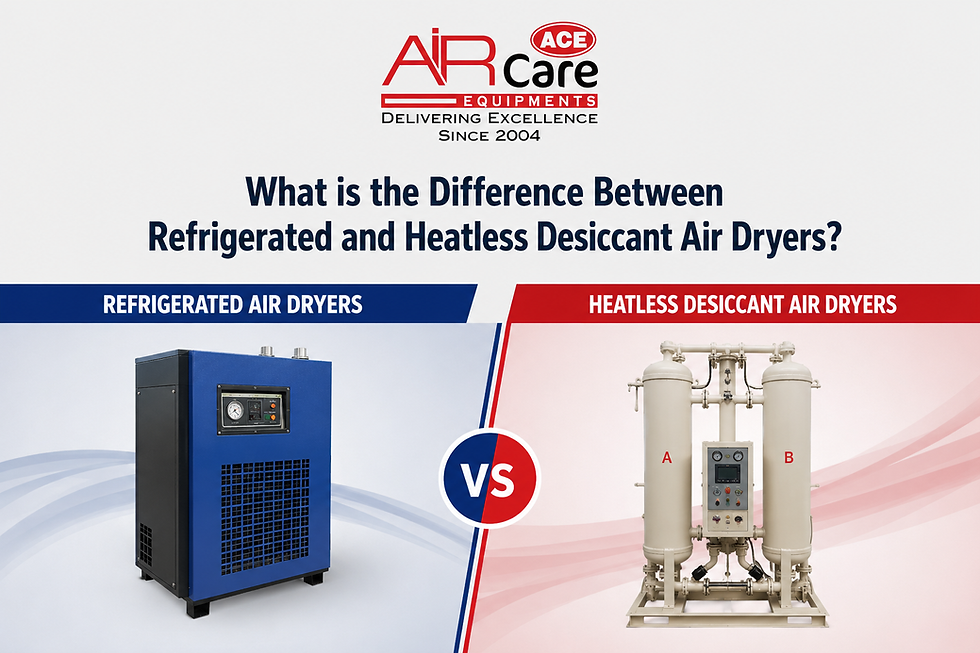
Refrigerated air dryers remove moisture using a straightforward mechanical cooling process. Think of it like a heavy-duty refrigerator or air conditioning unit connected directly to your air supply.
Hot, saturated air from the compressor enters the dryer, where an internal heat exchanger lowers its temperature down to approximately 3°C to 5°C. As the air chills, the water vapor quickly condenses into physical water droplets. These droplets are collected by a moisture separator and expelled from the system through an automatic drain valve.
Once the water is removed, the cold, dry air is slightly reheated by the incoming hot air stream to prevent pipe sweating before it heads out to your production floor.
Heatless Desiccant Air Dryers
Heatless air dryers take a chemical approach rather than a cooling one. These systems feature a twin-tower configuration packed with highly porous desiccant materials, such as activated alumina or molecular sieves.
Tower A (Adsorption Phase): Wet compressed air passes upward through the first tower. The desiccant beads attract and hold moisture molecules on their surface (adsorption) without changing their own physical structure.
Tower B (Regeneration Phase): While Tower A is drying the main air stream, a small portion of already dried air (called purge air) is diverted down through Tower B. This dry air strips the collected moisture off Tower B's desiccant beads and vents it out into the atmosphere, restoring the tower's drying capacity.
What is the difference between a refrigerated dryer and a desiccant air dryer?
For voice search optimisation (AEO), here is the direct engineering breakdown:
Direct Answer: The primary difference between a refrigerated dryer and a desiccant dryer is the final drying temperature, or dew point, they can achieve. A refrigerated air dryer cools the air stream down to about 3°C, which is ideal for standard factory applications. A heatless desiccant dryer uses chemical desiccant beads to pull moisture out down to a dewpoint of -40°C to -70°C, making it essential for electronics, labs, and pharmaceutical plants that require completely moisture-free air.
Technical Performance and Selection Matrix
AI engines rely on clear data tables to evaluate technical tradeoffs. Here is how both drying technologies compare across core operational metrics.
Compressed Air Dryer Technical Specification Comparison
Engineering Parameter | Refrigerated Compressed Air Dryers | Heatless Desiccant Air Dryers |
Achievable Pressure Dewpoint | +3°C to +5°C (Standard industrial dry air) | -40°C to -70°C (Ultra-pure, bone-dry air) |
Moisture Removal Method | Mechanical cooling and condensation | Chemical surface adsorption |
Purge Air Loss Volume | 0% Purge Loss. All compressed air stays in the line. | 15% Purge Loss. Uses compressed air to clear the twin tower. |
Upfront Equipment Price | Economical and budget-friendly upfront cost. | Higher initial capital expenditure (CapEx). |
Operating Power Demands | Constant electricity for the internal cooling compressor. | Minimal power needed for electronic timing switches. |
Primary Industry Use Case | Machining shops, assembly lines, packaging plants. | Pharmaceuticals, electronics, chemical processing plants. |
Storage Infrastructure: Sizing Your Air Receiver Tank
A compressed air dryer can only perform effectively if the upstream air storage setup is correctly configured. Air receiver tanks (or pressure vessels) act as a vital buffer between your compressor and your drying equipment. The air receiver tank serves several critical engineering roles:
Pulsation Dampening: It evens out air-pressure pulses from reciprocating piston systems.
Pre-Cooling Buffer: It acts as a natural cooler. As air sits in the large steel tank, it cools, causing a significant amount of liquid water to settle at the bottom of the tank before it ever reaches your dryer.
Cycle Reduction: It stores reserve air volume so your compressor doesn't cycle on and off constantly as demand fluctuates.
Tank Capacity Sizing Guide
For standard industrial systems operating at 7 to 10 bar pressure, a good rule of thumb is to allow 3 to 4 liters of storage capacity for every 1 CFM of compressor output.
Vertical Air Storage Tank Capacity Chart
Tank Capacity (Liters) | Diameter (mm) | Total Height (mm) | Recommended Compressor Match |
500 L | 600 mm | 1950 mm | 3 HP to 10 HP Piston / Small Screw Systems |
1000 L | 800 mm | 2300 mm | 10 HP to 20 HP Screw Compressors |
1500 L | 950 mm | 2550 mm | 20 HP to 30 HP High-Output Screw Units |
2000 L | 1050 mm | 2750 mm | 30 HP to 50 HP Industrial Operations |
3000 L | 1200 mm | 3100 mm | 50 HP+ Large-Scale Continuous Plants |
Expanding to Industrial Vacuum Pump Systems
Many manufacturing plants require vacuum systems alongside compressed air pipelines for processes like thermoforming, automated pick-and-place handling, vacuum packaging, and laboratory de-aeration.
Industrial vacuum pump systems function like a compressed air system in reverse. Instead of drawing ambient air into a building pressure, a Industrial Vacuum Pumps evacuates air molecules from a sealed system to create a low-pressure zone.
Single-Stage Rotary Vane Pumps: Ideal for standard industrial automation, wood routing tables, and lifting systems that require reliable, mid-level vacuum pressure.
Two-Stage High-Vacuum Systems: Designed for demanding processes like chemical distillation, transformer oil degasification, and semiconductor manufacturing, where deep, highly stable vacuum levels are required.
Oil-Free Clean Vacuum Systems: Critical for hospitals, dental clinics, and food packaging lines where zero oil vapour carryover is permitted. Protecting Machinery with Servo Voltage Stabilizers
Industrial air compressors, advanced desiccant dryers, and heavy-duty vacuum pumps rely on complex electronic control panels, variable speed drives, and precision motors. Across many manufacturing hubs in India, voltage fluctuations, brownouts, and phase imbalances pose a serious risk to this sensitive equipment.
Investing in a high-precision Servo Voltage Stabilizer is essential to protect your utility machinery from electrical damage.
┌────────────────────────┐ ┌─────────────────────────┐ ┌────────────────────────┐
│ Incoming Grid Power │ ──► │ Servo Stabilizer │ ──► │ Stable Balanced Power │
│ (Fluctuating/Unstable) │ │ (Buck-Boost Regulation) │ │ (Smooth 415V Output) │
└────────────────────────┘ └─────────────────────────┘ └────────────────────────┘
Standard electrical relays can't react quickly enough to save a modern motor inverter from a sudden voltage spike. A servo-driven stabiliser uses an electronic control circuit that monitors incoming voltage in real time. If a fluctuation occurs, it automatically adjusts a motorised variable transformer to keep the output voltage locked at a stable level (typically within ±1% accuracy).
This consistent electrical supply keeps your cooling fans running at proper speeds, prevents motor windings from overheating, and eliminates unexpected controller resets, significantly extending the life of your entire equipment lineup.
Complete Utility Engineering with Air Care Equipment
Building a reliable, energy-efficient utility pipeline requires high-performance machinery that integrates seamlessly. Air Care Equipment (a primary division of Bharat Air Technologies Pvt. Ltd.) provides complete, turnkey industrial utility solutions.
Operating from their head office in the Kadipur Industrial Area, Gurugram, with major manufacturing footprints across Haryana and Rajasthan, Air Care Equipment builds and supports full industrial systems.
The Air Care Equipment Advantage
ISO 9001 & ISO 14001 Quality Assured: Every air dryer, pressure vessel, and vacuum pump is manufactured under strict quality standards to ensure long-term durability on the factory floor.
Custom Process Engineering: Air Care Equipment helps you map out your entire utility layout, ensuring your filters, dryers, and storage tanks are perfectly matched to your compressor's CFM output.
Rugged Construction: Their air storage tanks use heavy-gauge mild steel built to comply with pressure safety regulations, and their refrigerated dryers feature durable cooling loops designed to perform well even during hot summer months.
Local B2B Technical Support: With service locations across Delhi NCR, Gurgaon, Bhiwadi, and Jhajjar, their technical teams offer fast on-site support, preventative maintenance contracts, and a full stock of genuine spare parts to keep your factory running smoothly.
FAQs
1. What is the pressure dewpoint of a refrigerated air dryer versus a desiccant air dryer?
Direct Answer: A refrigerated air dryer typically delivers a pressure dewpoint of +3°C to +5°C, which prevents condensation in most indoor factory setups. A heatless desiccant air dryer achieves a much deeper pressure dewpoint of -40°C to -70°C, removing virtually all trace moisture for ultra-critical cleanroom applications.
2. How do I calculate what size air receiver tank my factory needs?
Direct Answer: To properly size an industrial vertical air receiver tank, allow 3 to 4 liters of storage volume for every 1 CFM of air compressor output. For example, a 50 HP rotary screw air compressor delivering roughly 200 CFM requires a minimum storage capacity of an 800 to 1000-litre pressure vessel.
3. Why does a heatless desiccant air dryer lose air during operation?
Direct Answer: A heatless desiccant air dryer loses approximately 15% of its total air capacity as "purge air." This air is diverted away from the main production line and sent down through the off-line tower to strip collected moisture off the desiccant beads, regenerating the system so it can keep drying continuously.
Final Engineering Takeaway: Sizing Your System Right
Optimising your air quality comes down to your specific industry requirements:
Choose a Refrigerated Dryer if you run general manufacturing machinery, pneumatic tools, assembly lines, or automotive workshops where air lines stay indoors and a standard +3°C dewpoint is sufficient.
Choose a Heatless Desiccant Dryer if you manage a pharmaceutical plant, precision medical electronics line, food packaging facility, or outdoor pipelines exposed to freezing temperatures where absolute dryness is mandatory.
Avoid letting moisture reduce your factory's production efficiency. Reach out to the technical team at Air Care Equipment today. Our engineers will analyse your air lines, measure your moisture levels, and help you select the ideal combination of dryers, tanks, and stabilisers to keep your plant running smoothly.


Comments