


Oil-Free Air Compressors: Working, Types, Benefits, and Industrial Applications
- Jan 5
- 4 min read

Compressed air is a critical utility for modern industries, but the quality of that air can directly impact product safety, equipment life, and regulatory compliance. For industries where air purity is non-negotiable, Oil Free Air Compressors have become the preferred solution. Designed to deliver clean, uncontaminated air, these systems support industries that demand precision, hygiene, and reliability. At Air Care Equipments, we specialise in providing advanced oil-free compressed air solutions engineered to meet the highest industrial standards. This blog explores how oil-free air compressors work, their types, essential supporting equipment, and why they are the ideal choice for clean air applications.
Understanding Oil-Free Air Compressors
Oil-free air compressors are systems that compress atmospheric air without using oil in the compression chamber. Unlike traditional compressors, where oil is used for lubrication, sealing, and cooling, oil-free designs rely on advanced materials, special coatings, water injection, or air cooling to manage friction and heat.
This ensures that the compressed air remains completely oil-free, eliminating the risk of contamination in sensitive processes. As industries move toward stricter quality and environmental standards, oil-free air compressors are becoming increasingly essential.
How Oil-Free Air Compressors Work
The working mechanism of oil-free air compressors varies by design, but the principle remains consistent: compress air without oil contact.
Air Intake and Filtration
Ambient air enters the compressor through a high-efficiency intake filter that removes dust and airborne particles. This pre-filtration is crucial for maintaining internal component life and ensuring clean output.
Compression Process
In oil-free systems, air is compressed using pistons, screws, or scroll elements that are either coated with self-lubricating materials or cooled by water.
No oil is introduced into the compression chamber at any stage.
Heat generated during compression is dissipated using air or water cooling systems.
Moisture Removal and Air Treatment
Compressed air naturally contains moisture. To maintain air quality, the compressed air passes through separators and a Compressed Air Dryer, ensuring dry and clean air delivery.
Storage and Distribution
The treated air is stored in an Air Receiver Tank, which stabilises pressure and ensures consistent air flow to downstream equipment.
Types of Oil-Free Air Compressors
Oil-Free Reciprocating Air Compressor
A Reciprocating Air Compressor uses a piston and cylinder arrangement to compress air. In oil-free versions:
Pistons use advanced non-lubricated rings
Friction is reduced using specialised coatings
Ideal for low to medium air demand
Applications: Laboratories, dental clinics, packaging units, and small manufacturing facilities
Oil-Free Rotary Screw Compressor
A Rotary Screw Compressor compresses air using two intermeshing rotors that operate continuously. Oil-free rotary screw compressors:
Use water or precision coatings instead of oil
Deliver a steady supply of compressed air
Offer high efficiency and low pulsation
Applications: Pharmaceuticals, food and beverage plants, electronics manufacturing, and textile industries|
Oil-Free Scroll Compressors
Scroll compressors use spiral elements to compress air smoothly and quietly. These compressors are:
Compact and low-noise
Highly energy efficient
Minimal maintenance systems
Applications: Hospitals, research labs, medical and dental facilities
Importance of Supporting Equipment in Oil-Free Systems
Air Receiver Tank
An Air Receiver Tank is a vital component in any compressed air system. It helps:
Balance demand fluctuations
Reduce compressor cycling
Allow moisture to settle before air distribution
At Air Care Equipments, we emphasise correct tank sizing to enhance system efficiency and prolong compressor life.
Pressure Vessels and Safety Compliance
Air receivers are classified as pressure vessels and must be designed to withstand operating pressure safely. Choosing a trusted Pressure Vessel Manufacturer ensures:
Compliance with ASME and national safety standards
Enhanced operational safety
Long service life and reliability
High-quality pressure vessels reduce the risk of leaks, failures, and downtime.
Compressed Air Dryer
Even oil-free compressed air contains water vapour. A Compressed Air Dryer is essential to:
Prevent corrosion in pipelines
Protect pneumatic tools and equipment
Maintain product quality in sensitive industries
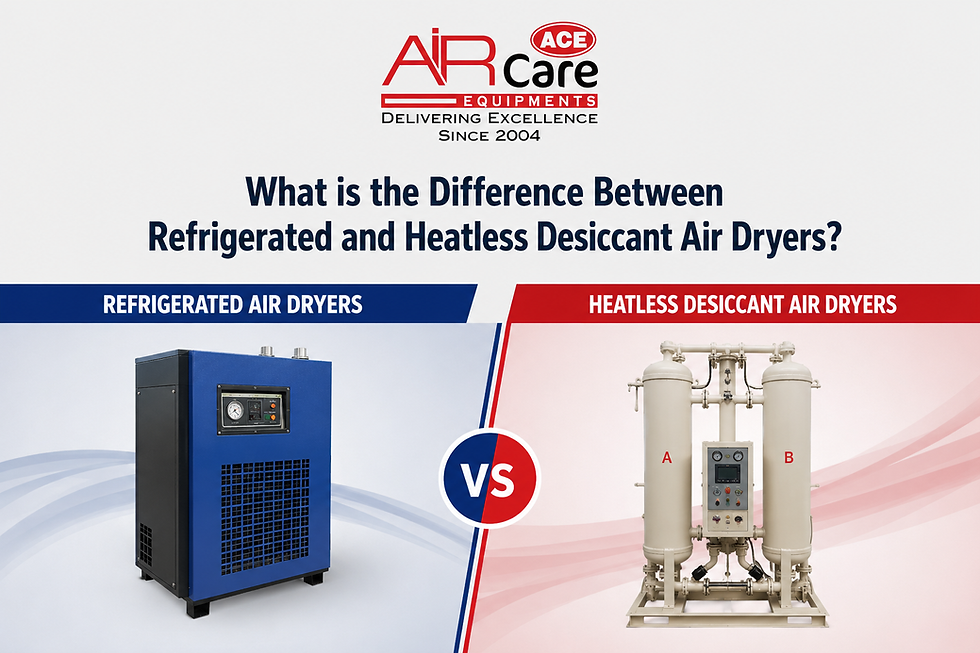
Depending on application requirements, refrigerated or desiccant dryers can be integrated into the system.
Advantages of Oil-Free Air Compressors
Zero Risk of Oil Contamination
Oil-free air compressors deliver pure compressed air, protecting products and processes from oil carryover.
Regulatory Compliance
Industries such as pharmaceuticals and food processing must meet strict air quality standards. Oil-free systems help achieve ISO Class 0 air quality.
Reduced Maintenance Costs
With no oil changes or oil filters required, maintenance becomes simpler and more cost-effective.
Environmentally Responsible
Oil-free technology eliminates oil disposal and minimises environmental impact.
Improved Product Quality
Clean air directly translates into higher product consistency and reduced rejection rates.
Industries That Benefit from Oil-Free Air Compressors
Pharmaceuticals: Capsule filling, fermentation, packaging
Food & Beverage: Bottling, mixing, and conveying
Electronics: Cleanroom manufacturing and assembly
Healthcare: Medical air systems and laboratory use
Textiles: Fibre processing and weaving
Automotive & Coating: Precision painting and finishing
Choosing the Right Oil-Free Air Compressor
When selecting an oil-free air compressor, consider:
Air flow and pressure requirements
Operating hours and duty cycle
Integration with an Air Receiver Tank and Compressed Air Dryer
Pressure vessel quality and certification
After-sales support and system design expertise
Air Care Equipments provides end-to-end compressed air solutions, helping industries choose the right technology for maximum efficiency and reliability.
Conclusion
Oil Free Air Compressors are the foundation of clean, safe, and efficient compressed air systems. Whether it’s a Reciprocating Air Compressor for small applications or a Rotary Screw Compressor for continuous industrial operations, oil-free technology ensures superior air quality without compromise. When combined with a properly sized Air Receiver Tank, certified pressure vessels from a trusted Pressure Vessel Manufacturer, and an efficient Compressed Air Dryer, the result is a robust and future-ready compressed air system.
With a commitment to quality and performance, Air Care Equipments continues to deliver advanced oil-free air solutions that meet the evolving needs of modern industries.



Comments